A letter from your Krankenkasse, explained
Your Krankenkasse is your German health-insurance fund. Most of its letters are routine — but a few set your contribution or ask for proof, and those come with a date. Here is how to tell them apart.
Routine info letters have no deadline. A request for documents gives a date to respond, and a formal Bescheid (e.g. setting your contribution) carries a Widerspruch period — usually one month.
Common Krankenkasse letters
- Mitgliedsbescheinigung / Willkommen — membership confirmation or welcome letter. Informational; keep it, no deadline.
- Beitragsbescheid / Beitragsfestsetzung — sets your monthly contribution (relevant for voluntary or self-employed members). Formal Bescheid with a Widerspruch period.
- Anforderung von Unterlagen — a request for proof, often of income. Has a response date.
- Erinnerung / Mahnung — a reminder about unpaid contributions. Don’t ignore; unpaid health-insurance contributions can accumulate.
Contributions and income
For voluntary or self-employed members, contributions are based on income. If the fund estimated your income or used outdated figures, the amount can be too high. Send current proof; against a formal Bescheid you can file a Widerspruch within the deadline.
Krankenkasse Widerspruch letter (example)
For a formal Bescheid — a contribution you think is too high, or a rejected treatment or aid. Replace the placeholders in [brackets] and send it as a signed letter (post or fax) or through your Krankenkasse’s online portal if it offers a Widerspruch form; a plain email may not count.
[Your name]
[Your address]

[Name of your Krankenkasse]
[Address]

[Place, date]

Versichertennummer: [number]
Betreff: Widerspruch gegen den Bescheid vom [date]

Sehr geehrte Damen und Herren,

gegen den oben genannten Bescheid lege ich hiermit fristgerecht

    Widerspruch

ein.

Begründung: [e.g. Der Beitrag wurde auf Grundlage eines geschätzten
Einkommens festgesetzt. Mein tatsächliches Einkommen beträgt [amount] €
monatlich; der aktuelle Nachweis liegt bei.]
[or: Die Ablehnung der Kostenübernahme für [treatment/aid] ist nicht
gerechtfertigt, weil [reason]. Eine ärztliche Bescheinigung liegt bei.]

Ich bitte um erneute Prüfung und um eine schriftliche Eingangsbestätigung.

Mit freundlichen Grüßen

[Signature]
[Your name]
English meaning: „I hereby lodge, within the deadline, an objection (Widerspruch) against the decision of [date]. Reason: the contribution was based on estimated income; my actual income is [amount] per month, proof attached [or: the refusal to cover [treatment] is not justified because …, doctor’s note attached]. Please review again and confirm receipt.“ More on deadlines and other authorities in our appeal guide.
Don’t feel like filling this in yourself? With Smart, Mein Büro writes the letter from your scanned Bescheid – reference number, date and address already filled in. Have the letter drafted for you
Frequently asked
Which letters have a deadline?
My contribution looks too high — what now?
Can I ignore a request for proof of income?
Know which letter needs action
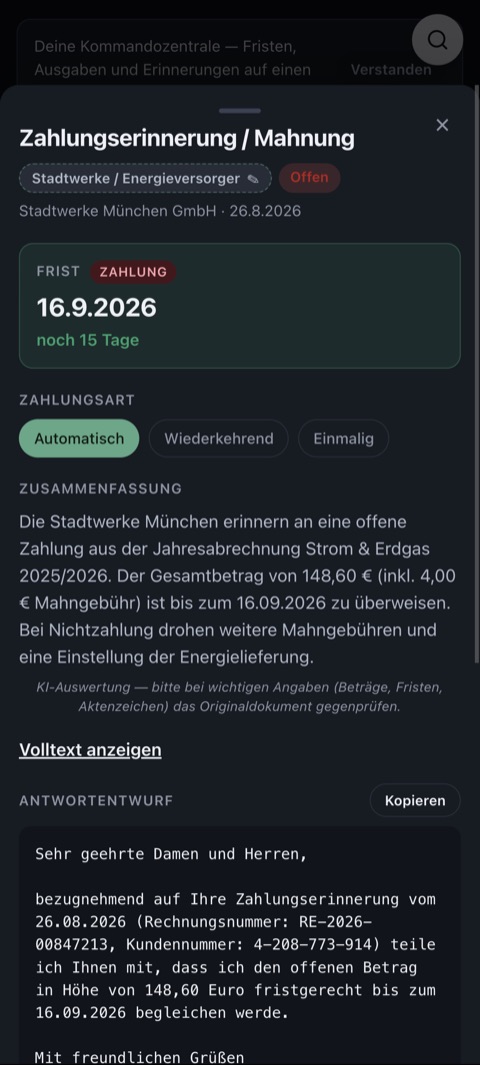
Upload a photo or PDF – Mein Büro finds the sender, the amount and the deadline, counts down the days and suggests what to do next. It can also draft your reply in German, ready to send to the authority.
Scan your first letter free5 scans/month free · no credit card · EU servers · Android app available