How to read a German Bescheid, step by step
Official German (Amtsdeutsch) often sounds more complicated than the matter really is. Once you know how a Bescheid is built and which words matter, you can find the decisive details in a few minutes — even if your German is still basic.
Almost every Bescheid comes down to three things: the decision (what is being settled), the amount or the claim, and the deadline (in the Rechtsbehelfsbelehrung at the end).
How a Bescheid is built
- Header: the issuing authority, the date and your Aktenzeichen (reference number).
- Subject / Tenor: the actual decision in one or two sentences.
- Reasons (Begründung): why it was decided that way, with the rules relied on.
- Payment part (if any): amount, due date, bank details, often with a payment QR code (GiroCode).
- Rechtsbehelfsbelehrung: which remedy is admissible, which deadline applies and to which office it must be addressed.
A sample Bescheid, line by line
The letter below is a fictitious sample (Muster) — names, numbers and bank details are made up. The German lines are typical wording; underneath each one you see what it means and what to look for.
- Header
Stadt Musterstadt · Bürgeramt · Musterstraße 1 · 12345 Musterstadt
Musterstadt, 06.10.2026 Who is writing and when. The date matters: a letter sent by ordinary post counts as delivered on the fourth day after it was posted, and the posting date usually follows from this date. - Reference Aktenzeichen: 32.1-4711/26 · Bitte bei Antwort angeben Your case number. Copy it into every reply, email or phone call — without it your letter may land on the wrong desk.
- Subject and decision (Tenor)
Gebührenbescheid
Für die Ausstellung des beantragten Dokuments wird eine Gebühr in Höhe von 45,00 € festgesetzt. The word Bescheid in the subject line tells you this is a formal decision. festgesetzt (set, fixed) means the amount is now officially owed. - Reasons (Begründung) Begründung: Die Gebühr ergibt sich aus der Gebührensatzung der Stadt Musterstadt … Why the authority decided this way. If you think something is wrong — a wrong amount, wrong facts, a missed document — this is the part your objection argues against.
- Payment part Bitte überweisen Sie den Betrag bis zum 05.11.2026 unter Angabe des Kassenzeichens 5.0123.456789.1 auf folgendes Konto: IBAN DE00 0000 0000 0000 0000 00 The due date for payment and the Kassenzeichen (payment reference). Put the Kassenzeichen in the transfer reference, otherwise your payment may not be matched.
- Rechtsbehelfsbelehrung Rechtsbehelfsbelehrung: Gegen diesen Bescheid kann innerhalb eines Monats nach Bekanntgabe Widerspruch erhoben werden. Der Widerspruch ist schriftlich oder zur Niederschrift bei der Stadt Musterstadt, Musterstraße 1, 12345 Musterstadt, einzulegen. The most important paragraph: you may object (Widerspruch) within one month of delivery (Bekanntgabe), in writing or in person at the office named. Some letters point to a lawsuit (Klage) at a court instead — always follow what your own letter says.
Terms that are often misunderstood
- Bescheid ≠ any letter – a reminder, a request for documents or an appointment invitation is not a decision. Only a Bescheid ends with a Rechtsbehelfsbelehrung and can be challenged with a Widerspruch or Einspruch.
- Frist ≠ due date – the deadline to object and the date by which you must pay are two different dates. Note both. An objection does not automatically pause the payment.
- Bekanntgabe ≠ the day you opened it – deadlines run from the deemed delivery date, not from when you found the letter. Being away on holiday does not move the date. How to count a German deadline, with an example.
- Widerspruch vs. Einspruch – both mean “objection”. Against most administrative decisions you file a Widerspruch; against a tax assessment or a fine notice, an Einspruch.
- Anhörung – a “hearing” letter. The authority has not decided yet and asks for your side first. Answering is your chance to change the outcome before the Bescheid comes.
- Aktenzeichen vs. Kassenzeichen – the Aktenzeichen identifies your case, the Kassenzeichen identifies your payment. Use the first in letters, the second in bank transfers.
The key terms
- Verwaltungsakt – the legally binding, single-case decision of an authority. A Bescheid is the most common form.
- Bekanntgabe – the moment from which the Bescheid takes effect and the deadlines start. For ordinary post usually the fourth day after posting (since 2025).
- Rechtsbehelfsbelehrung – the paragraph naming the remedy, the deadline and the responsible office. If it is missing, the deadline generally extends to one year.
- Aktenzeichen – the unique reference of your case; quote it in every reply.
- Säumniszuschlag – an additional charge that can arise on late payment.
- Vollstreckung / Mahnung – the steps taken when a due claim is not paid. See Mahnung: a German payment reminder, explained.
The letters newcomers usually get first
If you have just moved to Germany, the first months bring a predictable wave of post. Knowing which letters are decisions and which are just information saves a lot of worry.
- Anmeldung at the Bürgeramt: you register your address within two weeks of moving in and receive a Meldebestätigung (registration certificate). That is a confirmation, not a Bescheid. Keep it — banks, employers and other offices ask for it.
- Your Steuer-ID: after the Anmeldung, the Bundeszentralamt für Steuern sends your tax identification number (Steuerliche Identifikationsnummer) by post. It is an information letter with no deadline, but your employer needs the number, so keep it safe.
- Rundfunkbeitrag: the Beitragsservice often writes soon after the Anmeldung about the broadcasting fee per household. Early letters are information and registration requests; a Festsetzungsbescheid later on is a real decision with a deadline. The Rundfunkbeitrag explained.
- Ausländerbehörde / Blue Card: appointment invitations, requests for documents with a date, and decisions on your residence title. Dates in these letters matter a lot, and residence decisions often point to a Klage rather than a Widerspruch. A letter from the Ausländerbehörde, explained.
- Finanzamt: after your first tax return you receive a Steuerbescheid; against it you file an Einspruch within one month. A letter from the Finanzamt, explained.
- Krankenkasse: membership confirmations, contribution decisions and requests for income proof. A letter from your Krankenkasse, explained.
What you can do now
- Find and note the deadline – start with the Rechtsbehelfsbelehrung, then work out the end date as shown in our guide to German deadlines.
- Check the claim – make sense of the amount, the reason and the due date.
- Record the responsible office – the authority and the Aktenzeichen for your reply.
- Decide – pay, submit documents, or object. For an objection, use our Widerspruch guide with a letter template (German text plus English translation).
Frequently asked
What is a Bescheid?
What does Bekanntgabe mean?
Where do I find the deadline?
What is an Aktenzeichen?
Is every letter from an authority a Bescheid?
What if the Rechtsbehelfsbelehrung is missing?
Do I have to reply in German?
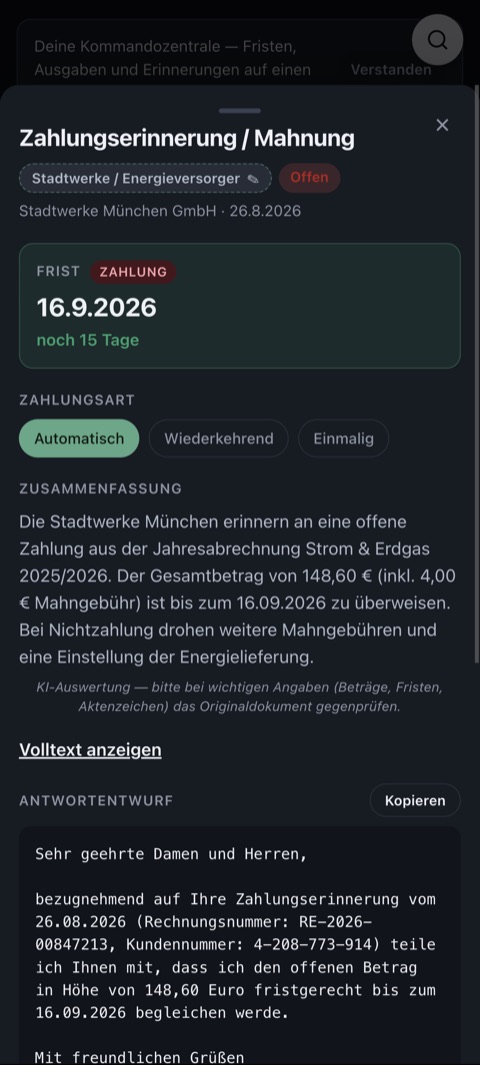
Don’t decode your Bescheid alone
Upload a photo or PDF – Mein Büro finds the sender, the amount and the deadline, counts down the days and suggests what to do next. It can also draft your reply in German, ready to send to the authority.
Scan your first letter free5 scans/month free · no credit card · EU servers · Android app available